
The Benefits of Winter Outdoor Play for Early Childhood Education
 As the thermostat dips, it’s easy to contemplate hibernation and forego any outdoor play. Within early childhood education, however, outdoor time is extremely important–no matter the season. It supports development in a way that indoor play simply cannot match. Throwing aside the old wives’ tale that the cold will make you sick, with the right clothing and smart supervision, cold weather play can be one of the happiest and healthiest parts of the day for both children and adults!
Let’s take a look at some of the benefits of getting outside in the crisp cool air, as well as some tips to help beat the cold.
We make a point to get outside daily when weather permits here at Bright Ideas. Call today to schedule a tour and check out our engaging outdoor play areas and playgrounds.
1) Big-Body Movement Builds Strong, Healthy Kids

Winter naturally invites “whole-body play” like stomping through crunchy grass, walking through the snow, moving around to warm up, climbing, balancing, tossing snowballs, or even sledding. Like a workout for a child, this kind of outdoor play helps strengthen muscles and develop coordination and balance. The CDC agrees that being physically active will support a child’s physical growth and development, and what better way than to challenge their bodies with the outdoors as their gym?
We aren’t scared of the heat or the cold here at Bright Ideas! When weather permits, we take play outside! Call us today to ask about our daily schedule’s room-to-room and how we make outdoor play a priority for every age group.
2) Outdoor Time Supports Focus, Mood, and Better Sleep
In the midst of the busyness of winter, outdoor play can be a much-needed outlet for pent up energy. The fresh air, natural light, and room to run can act as a ‘reset’ for young children–whether at home or attending daycare or preschool. The NAEYC highlights that time outside is linked to cognitive, social, and emotional gains for young children and can even support better sleep. Better sleep will help lead to better attitudes and a brain more ready to learn.
Here at Bright Ideas, we are ready to partner with your family to provide a solid foundation in early childhood education for your little one. Call us today to ask about our teaching philosophies and to schedule a tour to see our classrooms and meet our teachers.

3) Nature & Bright Light for Healthy Eyes
While the days are shorter and the sun seems to wane in its strength in the colder months, the available sunshine makes a huge difference in overall health, including with healthy eye development. According to the American Academy of Pediatrics (AAP), research shows that children who spend more time outdoors have a lower risk of developing myopia (nearsightedness), because bright outdoor light helps support normal eye growth during early childhood, which is a critical period for visual development.
Call today to schedule a tour with us here at Bright Ideas to see learning take place firsthand!
4) Winter Outdoor Play Grows Resilience and Confidence

Outdoor play encourages safe risk-taking such as climbing, balancing, navigating uneven ground, and even problem solving, such as: “How do we make a path?” “What happens if we pack the snow?” or “How do I get up the snowy hill?” The AAP emphasizes the “power of play” in building children’s brains and bodies—through experimenting, testing boundaries, and learning in real time. Learning is simply empowering, and outdoor play stretches children in a way that indoor play simply cannot.
Here at Bright Ideas, we know that learning extends far past worksheets and flashcards. Join us today to start your child’s early childhood education off on the right foot!
5) Safe Winter Outdoor Play
From home to childcare or to preschool or daycare, stepping outside–no matter the season–requires that you are prepared for the elements. Many times, winter is a struggle only because you or your child are simply not wearing the correct winter gear. Set yourself and your child up for success by acquiring and wearing appropriate winter clothing–and it goes further than simply donning a hat and coat. Here are some tips for keeping warm and safe when the temperature takes a dip:

- Wear Warm layers (base layer + insulating layer + waterproof outer layer)
- Hats, mittens, and dry socks. Planning snow play? invest in waterproof gloves.
- Shorter bursts outside on extra-cold days, with warm-up breaks
- Active games that keep bodies moving
We are happy to make sure your child is properly layered before heading out for some outdoor play. Let our teachers here at Bright Ideas know what you want your child to wear while venturing out and we will be sure to bundle them up.
The benefits of outdoor play are numerous, and they do not end with a specific season. So, gear up, head out, and take their early childhood education outside for some good, fun cold-weather-play!
What Skills Should My Child Have Before Kindergarten?

A lot of growth happens in the first five years of a child’s life. From helpless infancy to fully functioning little people, it can be quite the whirlwind! As primary school approaches, many parents find themselves asking the same important question: Is my child ready for kindergarten? Contrary to what you might think, kindergarten readiness isn’t found strictly in an age, or in memorizing ABC’s or even learning to read. Kindergarten readiness comes from a combination of social-emotional development, independences, communication, and other skills that are essential to early childhood education and will set them up for confident first steps into their primary school.
In this article, we will take a closer look at what it means to be ‘kindergarten ready’ and how you can help support your child on that path. Here at Bright Ideas, we work hard to prepare our preschoolers for kindergarten. Call us today to ask about our curriculum and teaching philosophies for each age group.
Social-Emotional Skills: The Heart of Kindergarten Readiness
A foundational skill to ensure kindergarten readiness is the ability to interact positively with others. Sharing, taking turns, managing emotions and following simple rules are all incredibly important to success, not just in a classroom setting, but in life! According to the National Association for the Education of Young Children (NAEYC), social and emotional development is just as important to children’s learning as academic skills.

Here at Bright Ideas, we place a big emphasis on kindness, quality friendships, and emotional growth every day. Give us a call to schedule a tour and learn more and to have the opportunity to see friendships blooming right before your eyes.
Independence and Self-Help Skills
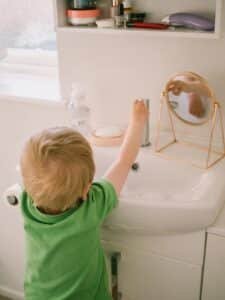 Basic self-care capabilities are huge to include as a part of getting ready for kindergarten–whether your child attends preschool, daycare, childcare, or stays home, these self-care tasks are essential with growing independence. Things like being able to use the bathroom by themself, washing their hands, dressing with minimal help and also participating in cleaning up and transitioning after activities.
Education-based school readiness research explains that everyday self-care skills like these help children feel more confident and capable in kindergarten because they can focus on learning instead of relying on constant adult assistance.
At our preschool and daycare, children practice independence through daily routines designed just for their age and stage. Come for a tour and chat with our early childhood education teachers to see what self-help skills they are encouraging within their classroom.
Language and Early Literacy Skills
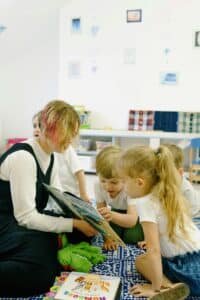 The Centers for Disease Control and Prevention (CDC) notes that many children entering kindergarten can recognize letters, write some letters in their name, and enjoy rhymes or songs. While not wholly necessary for beginning kindergarten, learning these things is a major piece of early childhood education, setting children up for an easier time as they move into a structured classroom setting. Reading with your child is a simple and way to nurture bonds and plant the seeds of early literacy skills.
As far as language skills and readiness, having the ability to follow simple directions, listen to stories, hold conversations and express their needs will greatly help your child adjust to a new group of friends, class, or school.
Reading is a major part of our days here at Bright Ideas. Schedule a tour and chat with our teachers about their classroom’s favorite reads.
Early Math and Problem-Solving Skills
Math skills within early childhood education can look like counting, recognizing patterns, sorting objects and even comparing sizes. The beautiful truth is that these skills often develop naturally through play–building blocks, puzzles, and games are all excellent at teaching and underlining early math skills in a fun way that children don’t even notice! Setting your child up for a confident experience in kindergarten with their math skills can be both fun and simple–Grab some new puzzles or practice counting the blocks of the highest tower you can make!

Research in early childhood education shows that young children naturally build early math skills through hands-on play with blocks, puzzles, and games, making play one of the most effective and engaging ways to support early numeracy before kindergarten.
We play and learn all day here at Bright Ideas because we know the power of learning through play! Contact us to ask about our classroom lesson plans and to schedule a tour to see play in action!
Building the Foundation for a Confident Start

Every child will develop at their own pace, and kindergarten readiness looks different from child to child and family to family–whether they have been in a preschool or daycare setting from the beginning, gone to childcare, or been home every day! Set your child up for a great start by giving them a well-rounded and quality early childhood education. Call us today here at Bright Ideas to ask about our enrollment opportunities and help your child take those first steps into school with confidence!
Helping Young Children Have a Smooth Transition After the Holidays
 The holiday season is full of excitement—special events, family gatherings, late bedtimes and a laxer schedule. While these times of throwing off the routine for the wonder of a season are lovely, returning to preschool, daycare, or childcare can feel overwhelming–for adults and children alike! Changes in routine, sleep, and expectations can unsettle even the most confident children.
Research consistently shows that predictable routines and supportive adult relationships help children feel safe and ready to learn–setting them up for a quality early childhood education. So, what do you do when the ‘regular’ is thrown off for the magic of a season or experience? That is exactly what we will look at in this article, with quality research to back up some excellent suggestions for resetting the daily routines.
Here at Bright Ideas Family we welcome the chaos and excitement that comes with the Holiday season and understand the emotional needs of our students during that time. We would love to be a part of your daily rhythm! Call us today to learn more about enrollment and join us here at Bright Ideas Family!
Start with Sleep
Sleep is everything, having a major impact on mood, behavior, and learning. The CDC recommends that preschool-aged children get 10–13 hours of sleep per day, including naps. If the holiday season has brought a major shift in schedule  changes, a gradual return to normalcy will help make an effective transition.
To reset after the holidays:
-
Shift bedtime earlier by 15–30 minutes every couple of nights
-
Keep wake-up times consistent
-
Institute a calming bedtime routine like reading or quiet music
Our daycare and preschool classrooms here at Bright Ideas Family helps support sleep hygiene and adequate rest! Call us up today to ask about our nap routines and to schedule a tour to see our center and meet our lovely teachers.
Prepare with Simple Conversations
Talking about what to expect helps reduce any uncertainty children might feel and fosters confidence in them! Simple, reassuring statements like “Tomorrow is a school day, and I’ll pick you up after naptime” can offer clarity and comfort as you transition back into a normal daily schedule. For early childhood education, quality communication and clear expectations sets children up for success. This type of responsive, back-and-forth communication between adults and children supports brain development and emotional regulation, a concept known as “serve and return” (source).
Our educators here at Bright Ideas Family know the value of solid communication. Schedule a tour today to chat with our teachers and ask about how we organize our daily communications with parents. 
Utilize Play and Movement
Play is a powerful item in the toolbelt of parents, preschool and daycare or childcare teachers. Experts in early childhood education emphasize that play-based learning supports emotional health, social skills, and attention—especially during times of change. In the time after the transitionary time after the holidays, preschool-aged children will greatly benefit from extra movement, imaginative play, and hands-on activities. While planning the day for your little one–whether at home, preschool, or daycare–keep in mind that children will have lots of extra mental and physical energy. Providing planned outlets for this will keep the day on track while keeping them engaged and on track as you ease back into daily rhythms. Plus, it’s fun!

Sensory, imaginative, and outdoor play are part of our daily schedule here at Bright Ideas Family! We would love to share our classroom lesson plans with you! Call today to schedule a tour and check out what our classes have going!
Keep Drop-Offs Calm and Consistent
A predictable drop-off routine helps children separate more easily–especially after a time of unpredictability like a holiday break. A simple routine such as, a brief hug or cuddle, a clear goodbye phrase, or a confident hand off to the teacher can make all the difference. Lingering or changing routines can increase anxiety. Instead, encourage trust and help children settle easily with a consistent and confident transition.
Our early childhood education teachers are very intentional to provide a warm and welcoming environment for their students and are also ready to support your morning goodbye routine, as well. Call today to ask about our classroom openings here at Bright Ideas Family and to schedule a time to come for a visit!
 Returning to ‘normal’
Returning to preschool or daycare (or work!) after the holidays can be emotional, but it can be made simpler with some extra grace, maybe another cup of coffee, and by patiently reinstituting daily rhythms. Don’t fret about thrown off schedules and late bedtimes! The whole family will bounce back into regular life before you know it!
We are ready to support your whole family through every transition here at Bright Ideas Family! Contact us today to schedule a tour and start your child’s enrollment!
Cozy Learning: Winter Activities That Support Early Childhood Education
 As temperatures drop and the wind starts to blow, preschool and daycare classrooms transform into warm and inviting spaces ready to be filled with learning and fun. This isn’t just a cozy way to pass the winter months, but an essential part of early childhood education. From sensory play to hands on learning games, research at ZERO TO THREE shows that young children learn best through playful, interactive experiences that strengthen fine motor skills, build language, and support overall development. Let’s take a look at some engaging and educational activities that will support your little one’s learning this winter!
Come for a tour here at Bright Ideas Family and see how our childcare program makes winter magical!
Fine Motor Play
Fine motor skills such as grasping, cutting, zipping, and drawing, are all foundational for independence and school readiness. Strengthening these little hand muscles will later help children write, use utensils, and learn how to manipulate their own buttons and zippers without assistance. Parents.com agrees that fine motor activities like cutting, pasting, and drawing give preschoolers critical practice that strengthens hand muscles, improves coordination, and prepares them for future writing tasks. 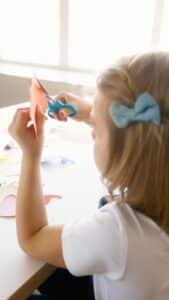
- Snowy playdough & “ice” sculpting
Rolling, pinching, and shaping playdough strengthens finger muscles needed for writing and cutting. Research highlights playdough as an effective early childhood fine motor tool (Source). Throw in some cute arctic animals for a nature-science edge to this play, as well! - Cutting paper snowflakes
Using scissors will engage a child’s bilateral coordination and concentration that will build skills for later handwriting success. - Practicing zippers, buttons, and mittens
Dressing for winter is a huge developmental workout! Not only will the practice support fine motor skills, but future independence, as well. - “Snow” sensory bins
Some cotton balls, rice, or kinetic sand and a spoon makes for easy-peasy play and learning! Scooping and pouring builds coordination, hand strength, and sensory regulation.
Here at Bright Ideas Family we intentionally plan activities around prepping for school readiness. Want to see what our early childhood educators have planned? Come for a visit and check out our well-thought-out lesson plans!
Building Language Skills

Winter is a language-rich season full of new experiences and vocabulary! Snow, winter clothing, holidays, and weather changes opens up a new world of learning. Daycare and childcare teachers as well as parents at home can use these natural moments as learning opportunities that build early childhood vocabulary!
- Dialogic reading during winter story time
Wondering what ‘dialogic reading’ is? Rather than reading a story straight through, teachers and parents alike stop to ask open questions, encourage predictions on where the story is headed, and invite children to retell portions of the story. Research shows that this helps children build vocabulary and narrative skills. - Seasonal songs and rhymes
Repetition helps little ones with memory retention as well as understanding sentence structure. The rhymes often found in songs and poems can help with reading readiness, as well! As Edutopia explains, playful rhyming and language games help children build phonemic awareness—a foundational early literacy skill—and support future reading success by training them to hear and manipulate the sounds in words. - Describing real winter experiences
The cold weather brings a host of new sensations! Naming the sensations children experience in the cold weather will challenge them to pay attention to and describe what they see/hear/feel/and smell out in the winter cold. Taking a moment for some connection and asking these little one’s to recount their snow adventures will strengthen their storytelling skills, as well.
Our language-rich classrooms provide an excellent environment for your child to build and grow their skills with new words and stories every day. Schedule a tour with us here at Bright Ideas Family and see our lessons first-hand.
Simple Winter Activities for Home
 Children are learning all the time! Support your little one’s early childhood education at home with a few simple, cozy activities: Winter learning doesn’t end at school. Families can support preschool growth at home with simple, cozy activities:
- Keep talking and reading— Research from the Reading Rockets shows that children whose parents read aloud regularly and engage in conversation build stronger vocabulary, better listening skills, and improved readiness for reading and learning.
- Offer fine-motor jobs like stirring batter, peeling clementines, velcroing shoes, or rolling playdough “snowballs.”
- Snuggle up with winter books and ask simple questions that help encourage comprehension.
The cold weather brings about a slew of learning opportunities! We would love to help you take advantage of those and support your child’s early childhood education in the classroom and at home, as well. Join us here at Bright Ideas Family and ask our teachers for activities that you can implement from home to support the daily classroom learning!
Safety First: What Parents Should Know About Choking Hazards and CPR
Keeping Little Ones Safe- Every Second Counts
When you’re caring for young children, safety isn’t just a checklist, it’s a mindset. At Bright Ideas, your child’s well-being is always our top priority. From snack time to playtime, our teachers follow strict safety protocols designed to prevent accidents and respond calmly and confidently if one occurs.
One of the most important (and often overlooked) safety topics for families is choking prevention and CPR readiness. These aren’t just classroom concerns; they’re life skills that every parent, caregiver, and teacher should understand.
Understanding Choking Risks in Early Childhood
Young children explore the world through touch and taste which means just about everything looks like a snack! Because their airways are smaller and their chewing skills are still developing, choking can happen quickly and unexpectedly.
According to the American Academy of Pediatrics (AAP), choking is one of the leading causes of injury in children under age four. But here’s the good news: most choking incidents are preventable through awareness, preparation, and proper food handling.
At Bright Ideas, our teachers are trained in both infant and child CPR and First Aid, ensuring we can respond immediately and effectively in emergencies. Our classrooms are designed with safety in mind from age-appropriate toys to supervised mealtimes.
Common Choking Hazards for Young Children
Many everyday foods and small objects can become dangerous if not managed carefully. Parents and caregivers should be aware of these common choking risks:
- Round or hard foods: grapes, cherry tomatoes, hot dogs, hard candies, raw carrots
- Sticky foods: peanut butter, marshmallows, or chunks of cheese
- Small toys and parts: beads, buttons, coins, LEGO pieces
- Household items: balloons, batteries, pen caps, jewelry
The CDC recommends cutting foods into pea-sized pieces for toddlers and quartering round items like grapes or cherry tomatoes. Encourage children to sit while eating, chew slowly, and avoid walking or talking with food in their mouths.
At Bright Ideas, mealtimes are calm, seated, and fully supervised like no running with snacks or distracted eating. Teachers use these moments to model safe habits and mindful eating behaviors.
What to Do If a Child Is Choking
Knowing what to do in the first few seconds can save a life. Here’s what trained caregivers (and parents) should do:
- Stay calm and assess quickly. If a child is coughing forcefully, encourage them to keep coughing.
- If the child cannot cough, speak, or breathe, call 911 immediately.
- For children over one year, use the Heimlich maneuver (abdominal thrusts):
- Stand behind the child, place your fist just above their navel, grasp it with your other hand, and thrust inward and upward until the object is expelled.
- For infants under one year, use back blows and chest thrusts:
- Support the infant face down on your forearm, deliver five firm back blows between the shoulder blades, then turn the baby over and give five gentle chest thrusts with two fingers.
If the child becomes unresponsive, begin CPR and continue until help arrives.
Every Bright Ideas teacher is trained to respond using these techniques and follows annual recertification through recognized organizations like the Red Cross and American Heart Association.
Why CPR Training Matters for Parents
While no one likes to think about emergencies, preparation makes all the difference. The AAP and Red Cross strongly encourage parents and caregivers to take a certified infant and child CPR course. These classes are hands-on and confidence-building, often offered locally or online in just a few hours.
Knowing what to do and staying calm while doing it can save precious seconds in an emergency. Even if you never have to use these skills, the peace of mind is invaluable.
Many families find it empowering to learn CPR together as a group. It’s a wonderful way for parents, grandparents, and babysitters to stay prepared and coordinated.
How Bright Ideas Prioritizes Safety
Our safety protocols go far beyond compliance. Every staff member at Bright Ideas:
- Maintains current CPR and First Aid certification
- Reviews monthly safety drills and emergency response plans
- Supervises children closely during meals and playtime
- Uses age-appropriate classroom materials and toys
- Follows cleaning and sanitizing routines that meet or exceed state standards
We believe that when parents and caregivers share the same knowledge, children stay safer everywhere — at home, in care, and beyond.
At Bright Ideas, your child’s safety is our promise. From CPR-trained staff to daily supervision and safe snack practices, we take every measure to protect the little ones you love most. Want to learn more about how we create a secure, nurturing environment for every child? Contact us or schedule a tour today — and see the ABC commitment to care in action.
Gentle Parenting: A Balanced Guide for Today’s Families
In a parenting landscape that’s ever-evolving, the term Gentle Parenting keeps surfacing. With its emphasis on empathy, respect, and connection, it stands in stark contrast to older, punitive-oriented methods. But what exactly does gentle parenting involve? And how can you use it effectively without feeling overwhelmed or lost in the “perfect parent” trap?
What Is Gentle Parenting?
Gentle parenting is a style that prioritizes relationship, emotional attunement, and inner growth rather than just behavior correction. It can be defined as offering consistent boundaries and responding to children with empathy and respect.
Key features include:
- Acknowledging children’s feelings and listening to them.
- Setting age-appropriate boundaries rather than resorting solely to punishments or rewards.
- Recognizing children as individuals with their own needs while guiding them.
- Focusing on understanding why behavior happens (emotion/need) rather than just “what” happened.
- Cultivating self-regulation and emotional intelligence in children.
In effect, gentle parenting invites parents and children to collaborate and communicate, rather than operate in a strict top-down authority model. Some researchers see it as part of the broader “positive parenting” movement.
Why Choose Gentle Parenting? The Potential Benefits
There are many reasons parents gravitate toward gentle parenting—and some evidence supports its benefits:
- Studies on positive parenting (which overlaps with gentle parenting) suggest that when children feel secure in their relationship with a parent, they tend to have better emotional well-being, fewer behavior problems, and better social adjustment.
- Gentle parenting emphasizes emotional awareness, teaching children to understand their feelings and behavior rather than simply obeying out of fear.
- It fosters a climate of respect and connection, which can enhance trust between parent and child, making guidance more effective.
- Because it aims to reduce reliance on rewards/punishments, it encourages children toward internal motivation and self-discipline—rather than only external compliance.
In short: when done thoughtfully, gentle parenting can support children to become resilient, emotionally aware, and socially competent while also helping parents feel more connected and less stuck in power struggles.
Practical Gentle Parenting Strategies You Can Use
 Here are some actionable tips to implement gentle parenting in your day-to-day:
- Validate feelings first.
Rather than starting with “Stop crying” or “Don’t be mad,” try: “I see you’re upset because we have to go now.” Acknowledging the emotion doesn’t mean you let everything slide—it means you begin with connection. - Set clear, consistent boundaries.
Gentle parenting doesn’t mean no rules. It means rules with respect. For example: “We hold hands in the parking lot because it keeps you safe.” Then follow through calmly if the boundary is broken. - Teach emotional language and self-regulation.
Help your child name their feelings: “You’re frustrated,” “You’re disappointed.” Then model what to do: “Let’s take three deep breaths together.” This builds their ability to regulate. - Offer choices within limits.
To reduce conflict, give children some control. For example: “Would you like your red shirt or the blue shirt today?” or “We’ll clean up in five minutes; do you want to drop the blocks or the books first?” This supports autonomy and cooperation. - Focus on connection rather than correction only.
If there’s misbehavior, explore with curiosity: “I notice you knocked over your sister’s tower—what were you feeling?” Then talk about consequences: “When we knock, we hurt feelings/towers fall. Next time you can ask instead.” This invites learning rather than just punishment. - Practice self-care as the parent.
Gentle parenting asks a lot of emotional labor. You’ll be modelling calm, empathy, and consistency. When you’re tired or stressed, it’s harder to stay gentle. Prioritize downtime, supports, and realistic expectations.
Common Misconceptions & Pitfalls to Avoid
While gentle parenting has many merits, it also comes with misunderstandings and challenges:
- Misconception: “Gentle means permissive.”
Not true. Gentle parenting still includes firm limits. If there are no boundaries, it loses its guidance element. - Misconception: “No discipline, no structure.”
Gentle parenting rejects harsh punishments, but it doesn’t reject the concept of teaching responsibility or consequences. The difference is in how it’s done—with empathy and respect. - Pitfall: Parental burnout or guilt.
Some parents practicing gentle parenting can feel high levels of self-criticism or pressure to be “perfect.” In one study a subset of gentle parents reported lower self-efficacy and high burnout. - Critique: Limited long-term research specifically on “gentle parenting.”
While much evidence supports positive parenting broadly, scholars note that “gentle parenting” as a distinct label still lacks extensive rigorous research. - Balance needed: It’s easy to swing into either extreme either becoming overly permissive or overly controlling. The sweet spot lies in empathy + boundaries.
Bringing It All Together: Gentle, Not Perfect
Gentle parenting is by no means easy, it asks us to lean into connection over control, listening over lectures, teaching over punishing. But it also asks us to set boundaries, stay consistent, and model behavior we wish to see in our children.
As you adopt this style:
- Start small. Pick one interaction per day where you pause and respond with empathy rather than default disciplining.
- Reflect. Ask yourself: Did my approach invite learning? Did it respect the child’s feelings?
- Accept imperfection. You will lose your cool; you will make mistakes. That is human. What matters is repair like “I’m sorry I yelled. Let’s try again.”
- Prioritize your own needs. Gentle parenting doesn’t mean ignoring your well-being; a well-rested, supported parent is more capable of gentle responses.
Ultimately, parenting is less about following a perfect style and more about building trust, security, and meaningful connection. Gentle parenting provides one powerful path toward that goal.